
Inconel 600 Manufacturing Process and Applications
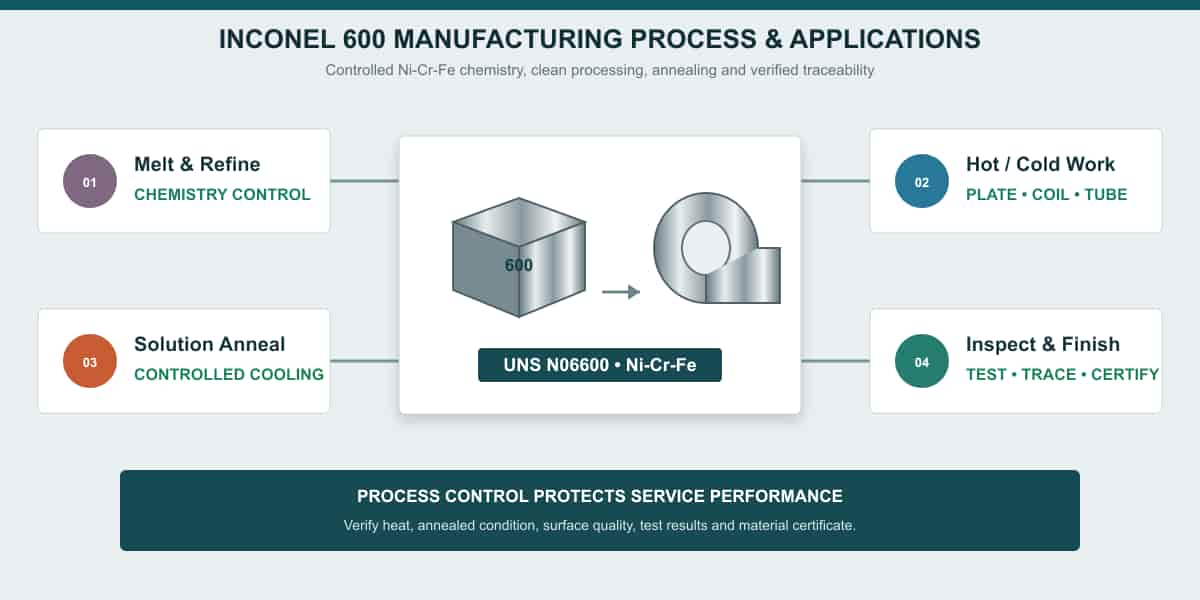
Inconel 600 is manufactured through controlled raw-material selection, melting, refining, ingot production, hot working, cold forming, annealing, surface finishing, and quality inspection. Its nickel-chromium-iron composition provides good resistance to oxidation, carburization, chloride-ion stress-corrosion cracking, caustic solutions, high-purity water, and many industrial atmospheres. Inconel 600 is a solid-solution-strengthened alloy rather than a precipitation-hardening grade, so its final properties depend mainly on composition, grain structure, cold-work level, annealing practice, surface condition, and product form.
Overview of Inconel 600
Inconel 600 is a wrought nickel-chromium-iron alloy identified as UNS N06600 and commonly associated with material number 2.4816. Its high nickel content provides a stable austenitic structure and resistance to many reducing and alkaline environments. Chromium improves oxidation resistance and performance in oxidizing conditions, while iron contributes to the alloy balance and manufacturing characteristics.
The alloy is nonmagnetic under many normal conditions and retains useful strength across a broad temperature range. It is not strengthened through a conventional aging treatment. Strength can be increased through cold working, while annealing restores ductility, modifies grain size, and prepares the material for forming or high-temperature service.
Available product forms include plate, sheet, strip, coil, bar, rod, wire, seamless tube, welded tube, seamless pipe, welded pipe, forgings, flanges, fittings, fasteners, and fabricated assemblies. Each product form has its own dimensional, mechanical, heat-treatment, surface, and testing requirements.
Principal Characteristics
- High nickel content and stable austenitic structure.
- Good resistance to oxidation and scaling at elevated temperatures.
- Useful resistance to carburizing and nitriding atmospheres.
- Strong resistance to chloride-ion stress-corrosion cracking compared with many austenitic stainless steels.
- Good performance in high-purity water and selected alkaline environments.
- Good forming and welding characteristics when nickel-alloy procedures are followed.
- Useful strength from cryogenic temperatures through elevated-temperature service.
Raw Material Selection and Chemical Composition Control
Production begins with high-purity nickel, chromium, iron-bearing materials, controlled alloy additions, and approved recycled Inconel 600 scrap. Recycled material must be positively identified, segregated, clean, and included in a documented charge calculation.
Foreign scrap, scale, paint, oil, cutting compounds, and mixed alloy turnings can introduce sulfur, copper, lead, phosphorus, tin, and other undesirable residuals. These contaminants may impair hot workability, welding behavior, surface quality, or high-temperature performance.
The production charge is calculated to account for alloy losses during melting and refining. Samples are taken during the melt, analyzed, and adjusted before casting. Final acceptance is based on the governing product specification rather than nominal website values.
| Element | Typical Specification Range, wt.% | Effect on Manufacturing and Performance |
|---|---|---|
| Nickel | 72.0 minimum | Provides the austenitic matrix, resistance to many reducing media, and resistance to chloride stress-corrosion cracking. |
| Chromium | Approximately 14.0–17.0 | Forms a protective chromium-rich oxide and improves oxidation and general corrosion resistance. |
| Iron | Approximately 6.0–10.0 | Controlled major constituent that affects alloy balance, processing behavior, and cost. |
| Carbon | Usually 0.15 maximum | Influences carbide formation, grain-boundary behavior, strength, and heat-treatment response. |
| Manganese | Usually 1.0 maximum | Supports melt processing and is controlled to maintain consistency. |
| Silicon | Usually 0.50 maximum | Affects deoxidation, scale formation, welding, and hot-working behavior. |
| Copper | Usually 0.50 maximum | Restricted residual element controlled for specification compliance. |
| Sulfur | Usually 0.015 maximum | Kept low because sulfur can impair hot ductility and cause severe attack in high-temperature reducing atmospheres. |
Chemical Analysis
Optical emission spectroscopy and X-ray fluorescence may be used for metallic elements. Combustion or inert-gas methods can measure carbon, sulfur, oxygen, nitrogen, and hydrogen when required. Instruments are calibrated using certified reference materials appropriate for nickel-base alloys.
Melting, Refining, and Ingot Production
Inconel 600 may be produced through electric furnace melting, vacuum induction melting, argon-oxygen decarburization, vacuum oxygen decarburization, or another qualified melting route. The selected process must achieve the required chemistry, cleanliness, gas content, and inclusion control.
Primary Melting
Primary melting combines nickel, chromium, iron, and controlled additions into a uniform liquid alloy. Temperature, stirring, slag chemistry, furnace atmosphere, refractory condition, and holding time are monitored to limit contamination and excessive oxidation.
Refining
Refining controls carbon, sulfur, dissolved gases, and nonmetallic inclusions. Chemical samples are analyzed before casting, and final additions may be made to compensate for melting losses. Excessive holding should be avoided because it increases refractory interaction and energy consumption.
Secondary Remelting
Electroslag remelting or vacuum arc remelting may be specified for products requiring improved cleanliness or a controlled ingot structure. These processes are not mandatory for every Inconel 600 specification. A purchaser requiring a particular melt route should state it explicitly.
Ingot Casting
The refined alloy is cast into an ingot, electrode, slab, or billet. Pouring temperature, mold design, insulation, cooling rate, and solidification direction influence shrinkage, segregation, and internal structure.
The ingot may receive a homogenization treatment to reduce chemical segregation before forging or rolling. The surface is inspected and conditioned by grinding, machining, or another qualified method to remove cracks, laps, deep scale, and casting defects.
| Stage | Main Control Objective | Risk if Uncontrolled |
|---|---|---|
| Charge preparation | Correct chemistry and clean raw materials | Residual contamination or incorrect alloy balance |
| Melting | Complete dissolution and uniform composition | Segregation, gas pickup, or refractory contamination |
| Refining | Control carbon, sulfur, gases, and inclusions | Poor weldability, hot cracking, or inconsistent properties |
| Casting | Controlled solidification and internal soundness | Shrinkage, segregation, cracks, or internal voids |
| Ingot conditioning | Remove surface defects before deformation | Seams, laps, or laminations in finished products |
Hot Forging and Hot-Rolling Processes
Hot forging, cogging, extrusion, and rolling convert the cast ingot into billet, slab, bar, ring, plate, or tube hollow. Hot deformation breaks down the cast structure, refines grains, distributes segregated regions, and helps close suitable internal discontinuities.
Inconel 600 has high hot strength and requires powerful equipment. The qualified working-temperature range depends on product form, reduction rate, section size, and manufacturer procedure. Uniform heating is important because cool edges or corners can crack during deformation.
Hot Forging
Forging is used for bar, billets, rings, flanges, fittings, discs, and shaped components. Large sections may require repeated reheating. Reduction should be distributed to produce a uniform structure and avoid excessive local strain.
Working below the qualified finishing temperature increases forging load and cracking risk. Excessive temperature or holding time can cause grain growth, heavy oxidation, or localized surface damage.
Hot Rolling
Slabs are hot rolled into plate or intermediate coil. Mill operators control pass reduction, roll force, temperature, edge condition, crown, and flatness. Scale is removed between suitable stages so it is not rolled into the surface.
Hot Extrusion
Seamless pipe and tube production may begin with piercing and hot extrusion. Billet preparation, lubrication, die design, extrusion ratio, and temperature influence wall uniformity and internal surface quality.
Cold Working and Forming Methods
Inconel 600 has good cold-forming capability but work-hardens more rapidly than mild steel. Cold rolling, drawing, bending, spinning, pressing, stamping, swaging, and pilgering may be used to reach final dimensions.
Cold Rolling
Cold rolling produces sheet, strip, and coil with controlled thickness, flatness, hardness, and finish. Multiple reductions may be separated by intermediate annealing when work hardening reduces ductility or exceeds mill capability.
Tube and Wire Drawing
Tube, rod, and wire products may be cold drawn through dies. Seamless tubing can also be cold pilgered to improve diameter, wall thickness, grain orientation, and surface finish. Lubricants must be removed before annealing.
Bending and Press Forming
Inconel 600 can be formed into vessel heads, furnace components, cylinders, cones, ducts, bellows, piping parts, and complex sheet-metal assemblies. Tooling should be smooth and sufficiently rigid, with suitable bend radii to avoid surface cracking.
Cold Work and Mechanical Properties
Cold work increases yield strength, tensile strength, and hardness while reducing ductility. It also creates residual stress and can influence stress-corrosion behavior. Components intended for demanding high-temperature or high-purity-water service should be evaluated in their final cold-worked and heat-treated condition.
Solution Annealing and Heat Treatment
Inconel 600 is a solid-solution-strengthened alloy and is not hardened through conventional precipitation aging. Heat treatment is used to restore ductility, recrystallize cold-worked material, control grain size, dissolve selected carbides, and establish properties appropriate for the intended service.
Annealing temperatures vary with product form and performance objective. Commercial treatments may use temperatures from approximately 870°C for lower-temperature stress-relieving or process annealing to more than 1100°C for full solution annealing or grain-size development. The exact cycle must follow the applicable specification and qualified supplier procedure.
Mill Annealing
Mill annealing produces a balance of strength, ductility, and formability for general product supply. The temperature and cooling method depend on thickness, amount of prior cold work, and required grain structure.
Solution Annealing
A higher-temperature solution treatment can dissolve carbides and restore a more uniform structure. It may also produce a larger grain size, which can benefit creep resistance but reduce room-temperature strength or fatigue performance. Higher temperature is therefore not automatically better for every application.
Cooling After Annealing
Cooling must be sufficiently controlled to achieve the intended carbide distribution and mechanical properties. Water quenching, rapid air cooling, or controlled furnace cooling may be used depending on section thickness, product form, dimensional requirements, and specification.
Furnace Atmosphere
Vacuum, inert gas, hydrogen, reducing atmosphere, or controlled air may be used. Sulfur-bearing contamination must be avoided because nickel alloys can suffer severe high-temperature sulfidation. Heavy scale or chromium-depleted surface layers should be removed before corrosive service.
Machining Characteristics and Recommended Techniques
Inconel 600 can be turned, milled, drilled, bored, threaded, broached, and ground using conventional machine tools. Its high ductility, work-hardening rate, and low thermal conductivity make it more difficult to machine than carbon steel.
Rigid Machine Setup
Machines and fixtures should be rigid, tool overhang should be short, and the workpiece should be supported near the cutting zone. Chatter damages the surface and shortens tool life.
Positive Cutting Action
The tool must cut beneath the previously work-hardened layer. Rubbing, dwelling, and repeated shallow passes should be avoided. Feed should be sufficient to maintain continuous engagement without exceeding machine or tool capability.
Cutting Tools
Sharp carbide tools with positive geometry are commonly used for production machining. High-speed steel may be suitable for selected slow-speed or interrupted operations. The best grade and coating depend on cut type, rigidity, coolant, and surface-finish requirements.
Coolant and Chip Control
Suitable coolant removes heat and flushes chips from the cutting edge. Nickel-alloy chips can be tough and stringy, requiring appropriate chip-breaker geometry. Cutting fluids must be removed completely when residues could affect welding, heat treatment, or food-processing service.
| Machining Factor | Recommended Practice | Practice to Avoid |
|---|---|---|
| Machine rigidity | Use rigid fixtures and minimum tool overhang | Flexible setups that allow vibration |
| Tool engagement | Maintain a continuous positive cut | Rubbing or dwelling on the surface |
| Tool condition | Replace worn or chipped edges promptly | Continuing until severe work hardening occurs |
| Heat removal | Apply suitable coolant and clear chips | Allowing heat to concentrate at the tool tip |
Welding Methods and Fabrication Considerations
Inconel 600 has good weldability when clean nickel-alloy procedures are used. Gas tungsten arc welding, gas metal arc welding, shielded metal arc welding, plasma arc welding, resistance welding, and submerged arc welding may be used with qualified procedures.
Filler Metals
ERNiCr-3 is a commonly selected bare filler for gas-shielded welding, while ENiCrFe-3 is commonly used for shielded metal arc welding. Filler selection must consider joint strength, service temperature, corrosion environment, dilution, dissimilar base metals, and construction-code requirements.
Joint Preparation
Oil, grease, moisture, paint, sulfur compounds, oxide, and embedded iron must be removed from the joint and adjacent surfaces. Tools and abrasives should be dedicated to nickel-alloy fabrication.
Heat Input and Interpass Temperature
Heat input and interpass temperature should remain within the qualified welding procedure. Excessive heat can enlarge the heat-affected zone and increase distortion. Preheating is normally unnecessary except to remove moisture or control a dissimilar-metal assembly.
Dissimilar-Metal Welding
Inconel 600 is frequently joined to stainless steel, carbon steel, and other nickel alloys. The filler metal must tolerate dilution and provide suitable strength and corrosion resistance. Thermal expansion differences and galvanic effects should be considered.
Postweld Treatment
Many Inconel 600 weldments are used without postweld heat treatment. Annealing may be required after severe forming, to meet a product specification, or to develop a particular structure. The selected cycle must also be compatible with adjacent materials.
Surface Treatment, Pickling, and Finishing
Hot working, welding, and air annealing can produce oxide scale and heat tint. These layers may conceal surface defects and can reduce corrosion performance if a chromium-depleted region remains beneath them.
Mechanical Cleaning
Grinding, brushing, machining, and controlled blasting can remove scale and defects. Abrasives must be clean and free from sulfur and iron contamination. Carbon-steel brushes and ordinary steel shot should not be used.
Chemical Pickling
Qualified industrial pickling processes may use nitric-hydrofluoric acid mixtures or proprietary formulations suitable for nickel-chromium alloys. These chemicals are hazardous and require specialist equipment, ventilation, protective procedures, and wastewater treatment.
Bright Annealing
Sheet, strip, wire, and tube may be bright annealed in vacuum or a controlled reducing atmosphere. Proper atmosphere purity and dew point help produce a clean surface with little scale. A bright appearance does not replace dimensional, mechanical, or cleanliness inspection.
Food and High-Purity Finishes
Food-processing, electronic, and high-purity components may require controlled surface roughness, polishing, degreasing, and documentation of cleaning agents. Finishing compounds must be removed from crevices and internal passages.
Quality Inspection and Applicable Standards
Quality inspection confirms chemistry, heat treatment, mechanical properties, dimensions, internal soundness, surface condition, and traceability. The inspection plan depends on product form, service severity, construction code, and purchaser requirements.
Material Testing
Heat analysis verifies melt chemistry, while product analysis may confirm composition in the finished material. Tensile testing measures yield strength, tensile strength, and elongation. Hardness, bend, impact, grain-size, creep, or corrosion testing may also be specified.
Nondestructive Examination
Ultrasonic testing is used for plate, bar, and forgings. Eddy-current or ultrasonic inspection may be used for tubing. Liquid-penetrant examination identifies surface-breaking defects, and radiographic inspection may be used for suitable welds.
Dimensional Inspection
Thickness, diameter, wall thickness, straightness, ovality, flatness, length, and surface finish are checked against the applicable specification. Pipe and tube may require hydrostatic, pneumatic, eddy-current, or leak testing.
| Standard | Typical Inconel 600 Product Coverage |
|---|---|
| ASTM B168 / ASME SB-168 | Plate, sheet, and strip |
| ASTM B166 / ASME SB-166 | Rod, bar, and wire |
| ASTM B163 / ASME SB-163 | Seamless condenser and heat-exchanger tube |
| ASTM B167 / ASME SB-167 | Seamless pipe and tube |
| ASTM B516 / ASME SB-516 | Welded pipe |
| ASTM B517 / ASME SB-517 | Welded tube |
| ASTM B564 / ASME SB-564 | Forgings, flanges, fittings, and related products |
| AWS A5.14 | Bare nickel-alloy wire and rods, including ERNiCr-3 |
| AWS A5.11 | Covered nickel-alloy electrodes, including ENiCrFe-3 |
The latest specification revision and project-specific supplementary requirements should be stated on the order. ASTM and ASME versions are not automatically interchangeable for all code-controlled construction.
Chemical Processing and Petrochemical Applications
Inconel 600 is used in chemical and petrochemical equipment where oxidation resistance, alkaline resistance, chloride stress-corrosion resistance, and elevated-temperature strength are required. Applications include heaters, evaporators, process piping, vessel components, catalyst-handling equipment, thermowells, and furnace connections.
Caustic and Alkaline Processing
The high nickel content gives Inconel 600 useful resistance to many caustic solutions. Performance depends on concentration, temperature, stress, and oxidizing contaminants. Hot concentrated caustic service requires environment-specific data and control of fabrication stress.
Chlorine and Hydrogen Chloride
Inconel 600 can resist dry chlorine and dry hydrogen chloride under appropriate conditions. Moisture can change the corrosion mechanism dramatically, producing hydrochloric acid and rapid attack. Dew point, shutdown condensation, and process purity must therefore be controlled.
Organic Chemical Processing
The alloy is used in selected fatty-acid, solvent, polymer, and organic-chemical systems. It is not a universal acid-resistant material and may be unsuitable for strongly reducing acids or aggressive wet chloride mixtures.
Heat Treatment and Industrial Furnace Applications
Inconel 600 has long been used in industrial furnaces because it combines oxidation resistance, hot strength, formability, and resistance to many carburizing atmospheres. Typical components include furnace muffles, retorts, trays, baskets, radiant tubes, roller-hearth parts, thermocouple protection tubes, fixtures, and heat shields.
In clean air, the alloy can provide useful oxidation resistance at temperatures approaching approximately 1095°C. This oxidation capability is not a universal allowable temperature for loaded components. Creep, distortion, thermal cycling, section thickness, and atmosphere may impose a substantially lower design limit.
Carburizing Atmospheres
Inconel 600 has useful resistance to carburization, but severe carbon activity and low oxygen potential can cause carbon penetration and internal carbide formation. Temperature, gas composition, carbon potential, and cycle duration determine performance.
Nitriding Atmospheres
The alloy can resist many nitriding environments, although ammonia content, nitrogen potential, temperature, and surface condition must be considered. Mixed carburizing-nitriding atmospheres may require application-specific testing.
Sulfur-Bearing Furnaces
Reducing sulfur-bearing atmospheres can be highly damaging to nickel-rich alloys because low-melting nickel sulfides may form. Fuel, lubricants, insulation, marking materials, and furnace deposits should be controlled to minimize sulfur exposure.
Nuclear Power and Energy Applications
Inconel 600 has an extensive history in nuclear power systems, particularly in steam-generator tubing, control-rod drive mechanisms, instrument components, penetrations, heat exchangers, and high-purity-water equipment.
Its high nickel content gives good resistance to high-purity water and chloride-ion stress-corrosion cracking. However, Alloy 600 has experienced primary-water stress-corrosion cracking in certain pressurized-water reactor environments and secondary-side corrosion in some steam generators.
Material condition, residual stress, water chemistry, temperature, cold work, fabrication history, and service time strongly affect susceptibility. Modern nuclear designs or replacement programs may use thermally treated Alloy 690 or another qualified alloy where improved resistance is required.
Existing Alloy 600 components are managed through water-chemistry control, inspection, repair, stress improvement, replacement, and plant-specific aging-management programs. Historical use should not be interpreted as automatic approval for a new nuclear component.
Other Energy Applications
Inconel 600 is also used in geothermal systems, power-plant heaters, waste-to-energy equipment, thermal-processing plants, and energy-conversion systems. Selection depends on whether oxidation, high-purity water, caustic chemistry, sulfur, chloride condensation, or mechanical loading controls service life.
Aerospace, Electronics, and Food-Processing Applications
Aerospace Applications
Inconel 600 may be used for engine seals, ducting, exhaust components, safety wiring, heat shields, and other moderately loaded hot parts. It is selected when oxidation resistance and fabrication are more important than the maximum creep strength available from precipitation-hardened superalloys.
Electronics and Electrical Applications
The alloy is used in electronic supports, electrode components, vacuum equipment, glass-to-metal processing fixtures, furnace hardware, and high-temperature electrical assemblies. Its electrical resistivity is much higher than copper, so it is normally selected for environmental and structural performance rather than efficient current conduction.
Food-Processing Applications
Inconel 600 can be used in heaters, evaporators, dryers, heat exchangers, and processing equipment exposed to heat, caustic cleaning, or selected food acids. Hygienic design still requires smooth surfaces, drainability, clean welds, controlled lubricants, and documented cleaning.
Food-contact acceptance depends on local regulations, equipment design, surface finish, and process chemistry. Alloy identity alone does not establish regulatory approval.
Inconel 600 Manufacturing and Application FAQs
How is Inconel 600 manufactured?
Inconel 600 is manufactured through controlled charge preparation, melting, refining, ingot casting, hot forging or rolling, cold working when required, annealing, controlled cooling, surface finishing, testing, and certification. The detailed route depends on whether the finished product is plate, sheet, strip, bar, wire, pipe, tube, or a forging.
Does Inconel 600 require heat treatment?
Inconel 600 is not precipitation hardened, but annealing is used to restore ductility, recrystallize cold-worked material, control grain size, and develop properties for the intended service. The required temperature and cooling method depend on product form, prior cold work, mechanical-property requirements, and applicable specification.
What are the main applications of Inconel 600?
Inconel 600 is used in chemical-processing equipment, industrial furnaces, heat-treatment fixtures, petrochemical heaters, nuclear and high-purity-water systems, aerospace ducting, electronic processing equipment, and food-processing machinery. Final selection must consider temperature, stress, atmosphere, water chemistry, sulfur, chlorides, fabrication condition, and required service life.
 English
  French
  German
  Italian
  Spanish
  Portuguese
  Arabic
  Korean