
Hastelloy C22 Manufacturing Process and Applications
Hastelloy C22 is manufactured through tightly controlled raw-material selection, melting, refining, casting, hot working, cold forming, solution heat treatment, rapid cooling, surface finishing, and quality inspection. Its carefully balanced nickel-chromium-molybdenum-tungsten composition provides broad resistance to both oxidizing and reducing chemicals, including mixed acids, chlorides, wet chlorine, oxidizing salt solutions, and contaminated process streams. Proper manufacturing is essential because chemical segregation, uncontrolled thermal exposure, slow cooling, surface contamination, or unsuitable welding practices can reduce the corrosion resistance expected from finished C22 plate, sheet, strip, bar, wire, pipe, tube, forgings, and fabricated equipment.
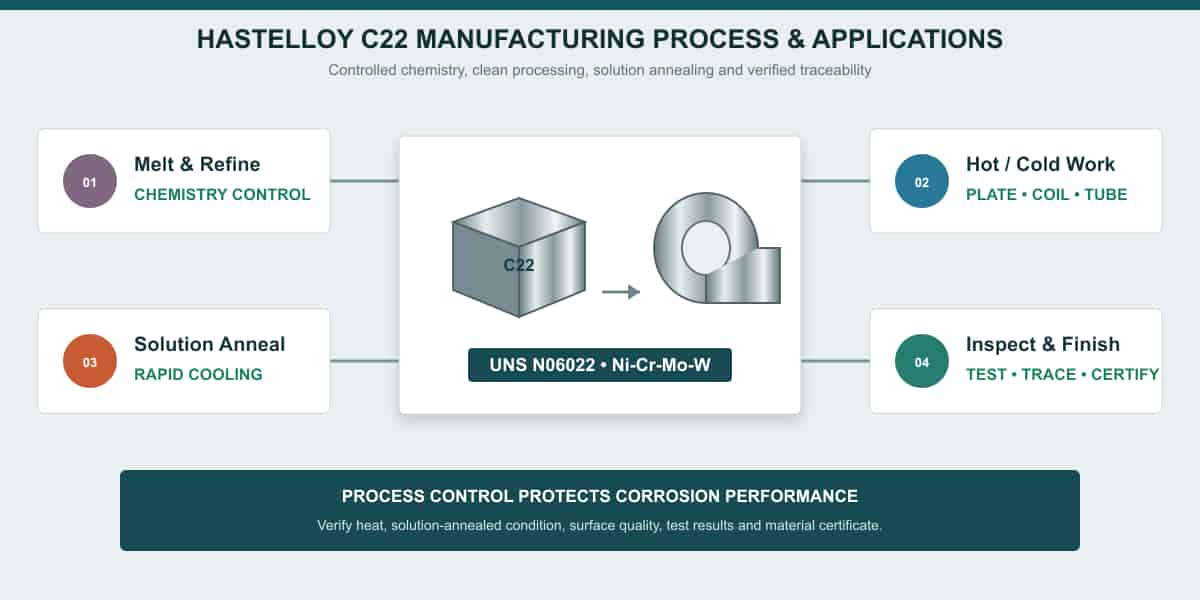
Overview of Hastelloy C22
Hastelloy C22 is a wrought nickel-chromium-molybdenum-tungsten alloy identified as UNS N06022 and commonly associated with material number 2.4602. It is designed for aggressive chemical-processing conditions where both reducing and oxidizing species may be present in the same process stream.
The alloy contains more chromium than Hastelloy C276, giving it particularly strong resistance to oxidizing chemicals and oxidizing contaminants. Molybdenum and tungsten provide resistance to reducing acids, pitting, and crevice corrosion, while the nickel-rich matrix supports performance in a broad range of industrial chemicals.
C22 can be supplied as plate, sheet, strip, coil, bar, rod, wire, seamless tube, welded tube, seamless pipe, welded pipe, forgings, flanges, fittings, fasteners, and fabricated process equipment. Product availability depends on dimensions, applicable standard, heat-treatment condition, inspection requirements, and supplier capability.
Why C22 Is Used in Mixed Chemical Environments
Many chemical processes do not remain purely oxidizing or purely reducing. Feedstock composition, cleaning cycles, catalysts, contaminants, start-up conditions, and temperature changes can alter the corrosion mechanism. C22 is useful because its chromium, molybdenum, and tungsten balance provides protection across a wider range of redox conditions than many conventional alloys.
Importance of Manufacturing Control
The correct chemical composition is only the beginning of C22 production. The alloy must also have a uniform microstructure, proper solution-annealed condition, clean surface, acceptable weld quality, and full traceability. A product with incorrect heat treatment or embedded iron contamination may not provide the expected corrosion performance even when its chemical analysis meets nominal limits.
Raw Material Selection and Chemical Composition Control
Manufacturing begins with high-purity nickel, chromium, molybdenum, tungsten-bearing additions, iron-bearing materials, and approved recycled alloy. Recycled C22 material can be used when it is positively identified, segregated, clean, and included in a controlled melt calculation.
Mixed scrap, cutting fluids, paint, scale, dirt, and foreign metal can introduce harmful residual elements. Lead, sulfur, phosphorus, copper, tin, and other contaminants can impair hot workability, welding behavior, surface quality, or corrosion resistance.
Each raw material is weighed according to a charge calculation that accounts for expected melting and refining losses. Samples are analyzed during production, and alloy additions are adjusted before casting when necessary.
| Element | Typical Specification Range, wt.% | Manufacturing and Performance Function |
|---|---|---|
| Nickel | Balance, commonly about 56 minimum | Forms the stable austenitic matrix and provides resistance to many reducing environments. |
| Chromium | Approximately 20.0–22.5 | Improves passivation and resistance to oxidizing acids, oxidizing salts, and high-temperature oxidation. |
| Molybdenum | Approximately 12.5–14.5 | Provides resistance to reducing acids, pitting, and crevice corrosion. |
| Tungsten | Approximately 2.5–3.5 | Supports localized-corrosion resistance and performance in reducing chemical environments. |
| Iron | Approximately 2.0–6.0 | Controlled constituent affecting structure, processing, and material balance. |
| Cobalt | Usually 2.5 maximum | Restricted residual element controlled for specification compliance. |
| Carbon | Usually 0.015 maximum | Kept low to reduce grain-boundary carbide precipitation during welding and heat exposure. |
| Silicon | Usually 0.08 maximum | Restricted to limit undesirable segregated phases and preserve corrosion resistance. |
| Manganese | Usually 0.50 maximum | Controlled for melt refining, cleanliness, and structural consistency. |
| Vanadium | Usually 0.35 maximum | Restricted residual that can influence processing and phase stability. |
These values are representative rather than purchasing limits. The latest applicable ASTM, ASME, EN, ISO, or customer specification must be used for acceptance.
Chemical Analysis Methods
Optical emission spectroscopy and X-ray fluorescence are commonly used to measure metallic elements. Combustion analysis may be used for carbon and sulfur, while inert-gas methods can determine oxygen, nitrogen, or hydrogen when required. Instruments must be calibrated using suitable reference materials.
Melting and Refining Processes
C22 requires a melting route capable of controlling carbon, silicon, sulfur, dissolved gases, nonmetallic inclusions, and metallic residuals. Producers may use vacuum induction melting, electric melting with argon-oxygen decarburization, vacuum oxygen decarburization, or another qualified primary melting process.
The exact route varies among manufacturers and product specifications. A particular commercial name does not establish whether the material was air melted, vacuum melted, electroslag remelted, or vacuum arc remelted. When the melt route matters, it must be stated on the purchase order.
Vacuum Induction Melting
Vacuum induction melting allows the charge to be melted and mixed under reduced pressure. It supports control of dissolved gases and reactive elements and can produce a chemically uniform electrode for subsequent remelting.
Argon-Oxygen and Vacuum-Oxygen Refining
Decarburization processes remove carbon while limiting excessive oxidation of valuable alloying elements. Gas flow, pressure, slag chemistry, temperature, and mixing are controlled to achieve the required low carbon content and clean melt.
Secondary Remelting
Electroslag remelting or vacuum arc remelting may be used to improve ingot cleanliness, reduce inclusions, and control solidification. Secondary remelting is not required by every C22 product standard, but it may be specified for critical aerospace, energy, or high-integrity applications.
| Production Stage | Main Objective | Potential Problem if Uncontrolled |
|---|---|---|
| Charge preparation | Accurate chemistry and clean raw materials | Residual contamination or incorrect alloy balance |
| Primary melting | Complete dissolution and chemical uniformity | Segregation, refractory contamination, or gas pickup |
| Refining | Control carbon, silicon, sulfur, and inclusions | Reduced weldability or corrosion resistance |
| Secondary remelting | Improve cleanliness and ingot structure | Internal discontinuities or inconsistent properties |
Casting and Ingot Production
After composition and cleanliness have been confirmed, the molten alloy is cast into an ingot, electrode, slab, or another intermediate shape. Casting temperature, mold condition, pouring rate, insulation, and cooling pattern influence the solidification structure.
Chromium, molybdenum, tungsten, and other elements do not distribute perfectly during solidification. Interdendritic segregation may develop, particularly in large ingots. The manufacturer controls ingot size, solidification rate, and subsequent homogenization to reduce these differences.
Homogenization
Homogenization holds the ingot at a controlled elevated temperature so diffusion can reduce chemical segregation. The temperature must be high enough to promote redistribution without causing localized melting, excessive oxidation, or uncontrolled grain growth.
Ingot Conditioning
The cast surface is inspected and conditioned by grinding, machining, scarfing, or another approved process. Surface cracks, laps, deep scale, and local casting defects must be removed because they can extend during hot working and appear as seams or laminations in finished products.
Heat Identification
Each melt receives a unique heat number. This identification follows the material through forging, rolling, heat treatment, cutting, inspection, and shipment. Traceability records connect the finished product to its chemical analysis and processing history.
Hot Forging and Hot-Rolling Processes
Hot forging, cogging, extrusion, or rolling breaks down the cast structure and converts the ingot into billet, slab, plate, bar, ring, or tube hollow. Controlled deformation refines the structure, distributes segregated regions, and helps close suitable internal discontinuities.
C22 has high deformation resistance and requires more powerful equipment than common stainless steel. The qualified hot-working temperature range depends on product form, deformation rate, section size, and manufacturer procedure. The material must not be worked after it has cooled below the approved finishing temperature.
Hot Forging
Forging is used for bars, billets, rings, flanges, fittings, and near-net-shape components. The workpiece is heated uniformly and reduced through a controlled sequence. Large reductions may require reheating to prevent edge cracking and excessive press loads.
Excessive heating can promote grain coarsening, heavy oxidation, or localized melting. Low-temperature deformation increases cracking risk and may create nonuniform residual strain.
Hot Rolling
Slabs are hot rolled into plate or intermediate coil. Pass reduction, roll force, temperature, edge condition, crown, and flatness are monitored throughout the process. Descaling prevents thick oxide from being rolled into the surface.
Hot Extrusion
Seamless pipe and tube production may begin with extrusion of a heated billet into a hollow. Billet preparation, piercing, lubrication, die design, temperature, and extrusion ratio influence dimensional quality and internal surface condition.
Cold Working and Forming Methods
C22 is ductile and can be cold rolled, drawn, bent, pressed, spun, or formed using equipment designed for high-alloy nickel materials. It work-hardens rapidly, so forming loads are higher than those required for many stainless steels.
Cold Rolling
Cold rolling reduces sheet and strip to final thickness while improving dimensional tolerance and surface finish. Intermediate solution annealing may be required when accumulated cold work reduces ductility or exceeds mill capability.
Cold Drawing and Pilgering
Tube and wire products may be cold drawn through dies. Seamless tube can also be cold pilgered to control diameter, wall thickness, and surface condition. Drawing lubricants and residues must be removed before heat treatment.
Bending and Press Forming
C22 can be formed into vessel heads, cylinders, cones, piping components, and complex fabrications. Tooling should have smooth surfaces and appropriate radii. Designers must account for springback, particularly in heavily cold-worked material.
Effect of Cold Work
Cold working increases hardness, yield strength, and residual stress while reducing ductility. Although higher strength may appear useful, uncontrolled cold work can alter corrosion and stress-corrosion behavior. Critical components should be evaluated in their final fabricated condition.
Solution Heat Treatment and Cooling
Solution heat treatment restores a uniform corrosion-resistant microstructure after hot or cold working. C22 is commonly solution annealed at approximately 1120°C or above, followed by rapid cooling. The exact temperature, holding time, transfer time, and cooling method must comply with the applicable product standard.
The purpose of solution annealing is to dissolve undesirable secondary phases, restore ductility, and retain chromium, molybdenum, and tungsten in the matrix. Insufficient temperature or holding time can leave harmful phases undissolved, while excessive treatment can cause grain growth or distortion.
Rapid Cooling
Rapid cooling minimizes the time spent in temperature ranges where carbides or intermetallic phases may form. Water quenching is commonly used for plate, bar, forgings, and heavy fabrications. Thin products may cool sufficiently rapidly by another approved method, but this must be supported by the specification and qualified procedure.
Section Thickness and Furnace Loading
Holding time begins only after the complete section has reached the required temperature. Closely packed furnace loads or large wall-thickness differences can produce uneven heating and cooling. Thermocouple placement, furnace uniformity, transfer time, and quench agitation are therefore important.
Heat-Treatment Atmosphere
Vacuum, inert gas, reducing atmosphere, or controlled-air furnaces may be used depending on the required finish. Sulfur-bearing furnace contamination must be avoided. Heavy scale and chromium-depleted surface layers must be removed before critical corrosion service.
Machining Characteristics and Recommended Techniques
Hastelloy C22 can be machined with conventional turning, milling, drilling, boring, threading, and grinding equipment. Machining is more demanding than carbon steel because C22 combines high strength, ductility, low thermal conductivity, and rapid work hardening.
Use Rigid Equipment
Machine tools, fixtures, and workholding should be rigid. Tool overhang should be minimized, and the workpiece should be supported near the cutting area to control vibration and chatter.
Maintain a Positive Cut
The cutting tool should remain below the previously work-hardened surface. Rubbing, dwelling, and repeated light passes should be avoided. Feed must be sufficient to maintain a positive cutting action without exceeding machine or tool capability.
Tool Selection
Sharp carbide tools with positive geometry are commonly used for production machining. High-speed steel may be appropriate for selected low-speed operations, complex tools, or interrupted cuts. Tool grade, coating, rake, and chip breaker should match the operation.
Coolant and Chip Removal
A generous supply of suitable cutting fluid removes heat and flushes chips away from the cutting zone. Coolant selection should consider the final service because sulfur- or chlorine-bearing residues can contaminate the surface if cleaning is inadequate.
| Machining Factor | Recommended Practice | Practice to Avoid |
|---|---|---|
| Machine setup | Rigid fixture and short tool overhang | Flexible setups that permit chatter |
| Tool engagement | Continuous positive cutting action | Rubbing or dwelling on the surface |
| Tool condition | Use sharp edges and replace worn tools | Continuing with chipped or glazed tools |
| Heat control | Apply appropriate coolant and remove chips | Allowing excessive heat buildup |
Welding Methods and Fabrication Considerations
C22 has good weldability when proper nickel-alloy procedures are followed. Gas tungsten arc welding, gas metal arc welding, shielded metal arc welding, plasma arc welding, and submerged arc welding may be used when supported by a qualified welding procedure.
Recommended Filler Metals
Matching filler metals commonly include ERNiCrMo-10 for gas-shielded processes and ENiCrMo-10 for shielded metal arc welding. Filler selection must also account for dilution, dissimilar base metals, service chemistry, joint strength, and the governing fabrication code.
Surface Cleanliness
Joint surfaces and nearby areas must be free from oil, grease, moisture, paint, oxide, sulfur compounds, and embedded iron. Dedicated stainless-steel brushes, clean abrasives, and tools reserved for nickel alloys help prevent contamination.
Heat Input and Interpass Temperature
Heat input should be controlled to limit the width of the heat-affected zone and unnecessary thermal exposure. Interpass temperature must remain within the qualified procedure. Preheating is normally unnecessary except to remove moisture or manage a dissimilar-metal assembly.
Postweld Heat Treatment
Many C22 fabrications can be placed in service in the as-welded condition because the alloy has low carbon and silicon contents. Complete solution annealing may be considered after severe forming, for particular code requirements, or when the most demanding corrosion performance is required.
Dissimilar-Metal Welding
C22 may be welded to stainless steel, nickel alloys, or other materials using a filler selected to tolerate dilution. The joint must be evaluated for galvanic corrosion, thermal expansion differences, service temperature, and the corrosion resistance of the diluted weld zone.
Surface Treatment, Pickling, and Finishing
Hot working, welding, and air heat treatment can create scale and heat tint. These oxides may conceal defects or leave a chromium-depleted region beneath the surface. Proper cleaning is required before critical chemical service.
Mechanical Cleaning
Grinding, brushing, machining, and controlled blasting can remove oxide and surface defects. Abrasives must be clean and dedicated to nickel alloys. Carbon-steel brushes, contaminated grinding wheels, and ordinary steel shot can embed iron and produce rust staining.
Chemical Pickling
Qualified pickling processes remove adherent oxide and expose a clean alloy surface. Industrial nickel-alloy pickling solutions may contain nitric acid, hydrofluoric acid, or proprietary chemical combinations. These are highly hazardous materials that require specialist equipment, ventilation, protective measures, and waste treatment.
Polishing and High-Purity Finishing
Pharmaceutical and high-purity equipment may require specified surface roughness, directional polishing, or electropolishing. Finishing procedures should remove embedded abrasive and polishing compound without introducing chlorides, sulfur, or free iron.
Surface treatment cannot repair incorrect solution heat treatment or deeply damaged material. If grinding or chemical cleaning does not fully remove a defect or depleted layer, additional material removal or component replacement may be necessary.
Quality Inspection and Applicable Standards
Inspection verifies that the finished C22 product meets chemical, mechanical, dimensional, surface, and traceability requirements. The inspection plan depends on product form, service severity, construction code, and purchaser requirements.
Chemical and Mechanical Testing
Heat analysis confirms melt chemistry, while product analysis may verify the finished material. Tensile testing typically measures yield strength, tensile strength, and elongation. Hardness, bend, impact, corrosion, flattening, flaring, or other tests may be specified.
Nondestructive Examination
Ultrasonic examination can identify internal discontinuities in plate, bar, and forgings. Eddy-current or ultrasonic testing may be applied to tube. Liquid-penetrant inspection detects surface-breaking defects, and radiographic testing can examine suitable welds.
Dimensional and Surface Verification
Thickness, diameter, wall thickness, straightness, ovality, flatness, length, and surface finish are measured against the relevant standard. Pipe and tube may also require hydrostatic, pneumatic, or leak testing.
| Standard | Typical Hastelloy C22 Product Coverage |
|---|---|
| ASTM B575 / ASME SB-575 | Plate, sheet, and strip |
| ASTM B574 / ASME SB-574 | Rod and bar |
| ASTM B622 / ASME SB-622 | Seamless pipe and tube |
| ASTM B619 / ASME SB-619 | Welded pipe |
| ASTM B626 / ASME SB-626 | Welded tube |
| ASTM B564 / ASME SB-564 | Forgings, flanges, fittings, and related products |
| AWS A5.14 | Bare nickel-alloy welding wire and rods, including ERNiCrMo-10 |
| AWS A5.11 | Covered nickel-alloy welding electrodes, including ENiCrMo-10 |
The latest revision and any supplementary requirements must be stated on the purchase order. ASTM and ASME versions may have similar technical content but are not automatically interchangeable for pressure-code construction.
Chemical Processing and Pollution-Control Applications
C22 is widely used in chemical processing because it resists both oxidizing and reducing conditions. This capability is valuable in plants where chemical composition changes during normal production, cleaning, start-up, shutdown, or process upset.
Applications include reactors, pressure vessels, heat exchangers, columns, agitators, piping, valves, pumps, filters, evaporators, expansion joints, and storage systems. C22 is considered for mixed acids, acetic acid, formic acid, chlorine chemistry, oxidizing salts, and chloride-contaminated chemical streams.
Wet Chlorine and Chloride Systems
The alloy provides strong resistance to wet chlorine, hypochlorite, chlorine dioxide, and many chloride-containing oxidizing environments. Temperature, concentration, pH, deposits, and crevice geometry still require evaluation.
Pollution-Control Equipment
C22 may be used in flue-gas desulfurization absorbers, scrubber vessels, ducting, dampers, spray headers, reheaters, stack liners, and wastewater equipment. Such systems can combine acidic condensate, chlorides, sulfur compounds, oxidizers, abrasion, and deposits.
Oil, Gas, Marine, and Power-Generation Applications
Oil and Gas
C22 may be used for valves, instrument components, seals, fasteners, tubing, chemical-injection systems, and process equipment exposed to chlorides, hydrogen sulfide, carbon dioxide, and treatment chemicals. Sour-service acceptance depends on hardness, cold work, heat treatment, temperature, stress, and applicable qualification requirements.
Marine Applications
C22 provides strong resistance to seawater pitting and crevice corrosion compared with common stainless steels. Potential applications include seawater piping, splash-zone components, heat-exchanger parts, fasteners, pumps, valves, and equipment exposed to polluted marine water.
Biofouling, deposits, stagnant crevices, galvanic contact, and high-temperature seawater must still be evaluated. Material selection should use service-specific data rather than a general seawater rating.
Power Generation
Power-generation uses include scrubbers, chemical-handling equipment, geothermal systems, waste-to-energy plants, flue-gas equipment, and selected heat-recovery systems. C22 is especially useful where oxidizing contaminants and reducing acidic species occur together.
Pharmaceutical, Pulp and Paper, and Waste-Treatment Applications
Pharmaceutical Equipment
C22 may be used for reactors, dryers, filters, piping, mixers, centrifuge components, and cleaning systems exposed to halides, solvents, active ingredients, or aggressive cleaning chemicals. Weld smoothness, surface roughness, drainability, documentation, and contamination control are important.
Pulp and Paper Processing
Bleaching operations can contain chlorine dioxide, chlorides, oxidizing chemicals, acidic liquor, and organic compounds. C22 may be used for bleach-plant piping, washers, mixers, valves, nozzles, vessels, and repair fabrications.
Waste-Treatment Systems
Industrial and hazardous waste streams can change significantly over time. C22 is valuable when acids, oxidizers, chlorides, sulfur compounds, solvents, and metal salts may occur together. Applications include evaporators, wet scrubbers, leach systems, piping, mixers, filter equipment, and treatment vessels.
The selection process should consider the most aggressive credible chemistry rather than the average waste analysis. Evaporation, deposits, cleaning chemicals, and shutdown condensation can produce conditions more severe than those measured in the bulk liquid.
Hastelloy C22 Manufacturing and Application FAQs
How is Hastelloy C22 manufactured?
Hastelloy C22 is produced through controlled raw-material preparation, melting, refining, casting, ingot conditioning, hot forging or rolling, cold working when required, solution annealing, rapid cooling, surface finishing, testing, and certification. The exact route depends on whether the final product is plate, sheet, strip, bar, wire, pipe, tube, or a forging.
What is the solution heat-treatment temperature for Hastelloy C22?
C22 is commonly solution annealed at approximately 1120°C or above and then cooled rapidly to retain a uniform corrosion-resistant structure. The precise temperature, holding time, furnace transfer time, and cooling method must follow the applicable product standard and qualified manufacturing procedure.
What are the main applications of Hastelloy C22?
Hastelloy C22 is used in chemical reactors, mixed-acid systems, wet-chlorine equipment, flue-gas scrubbers, oil and gas components, marine systems, pharmaceutical machinery, pulp and paper bleaching plants, power-generation equipment, and hazardous-waste treatment facilities. Final selection should be based on actual chemical concentration, temperature, contaminants, crevice conditions, stress, and required service life.
 English
  French
  German
  Italian
  Spanish
  Portuguese
  Arabic
  Korean