
Hastelloy C22 Corrosion Resistance: Acids, Chlorides, Seawater and Chemical Processing Applications
Hastelloy C22 corrosion resistance is based on a carefully balanced nickel-chromium-molybdenum-tungsten composition developed for severe and changing chemical environments. Also identified as Alloy C22, UNS N06022 and Werkstoff 2.4602, the alloy combines high chromium content with substantial molybdenum and tungsten additions. This chemistry provides strong resistance to oxidizing acids, reducing acids, chlorides, seawater, wet chlorine and mixed process streams. Hastelloy C22 also offers excellent resistance to pitting, crevice corrosion and chloride-induced stress corrosion cracking. Its actual performance depends on chemical concentration, temperature, contaminants, flow, deposits, welding quality and equipment design.
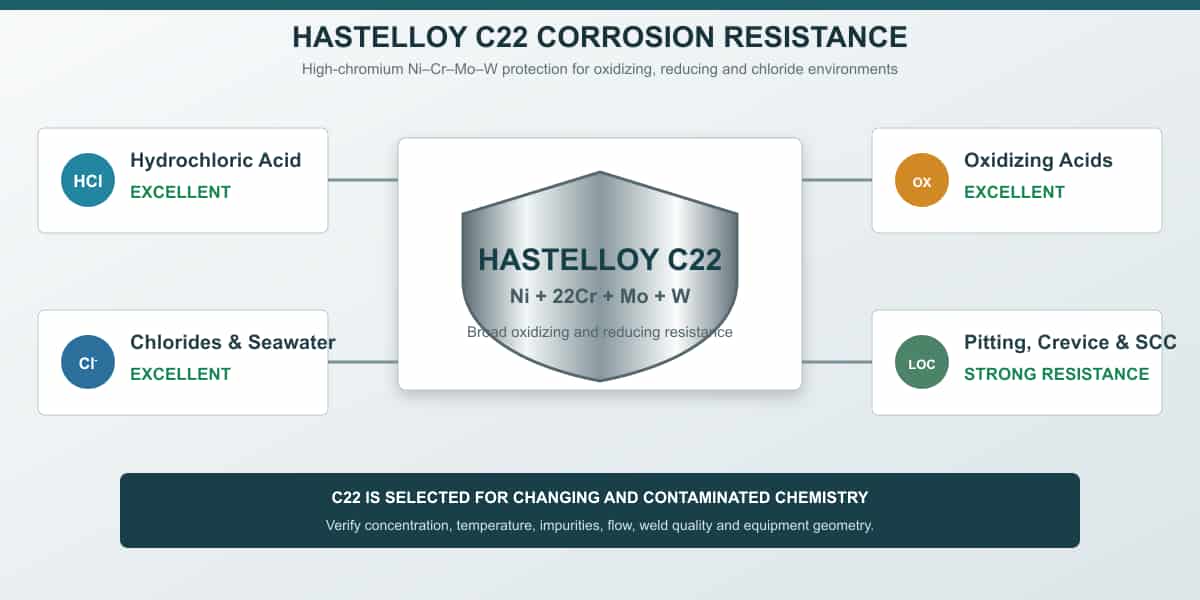
Overview of Hastelloy C22 Corrosion Resistance
Hastelloy C22 is a wrought nickel-based corrosion-resistant alloy designed for environments that may be too aggressive or too variable for conventional stainless steel. Its high chromium content provides strong oxidizing resistance, while molybdenum and tungsten support performance in reducing acids and chloride-bearing solutions.
The alloy is particularly valuable when the process chemistry changes between oxidizing and reducing conditions. Chemical reactors may experience different conditions during charging, reaction, cleaning, startup and shutdown. A material selected for only one steady-state chemical may perform poorly during another stage of the process.
Typical C22 applications include chemical reactors, process vessels, heat exchangers, scrubbers, piping, pumps, valves, evaporators, pharmaceutical equipment, waste-treatment systems and flue-gas desulfurization components.
Corrosion resistance does not mean that the material is completely immune to attack. Compatibility must be evaluated using the complete chemical composition, concentration, temperature, pressure, aeration, contaminants, flow velocity and exposure time.
Chemical Composition and Its Role in Corrosion Resistance
| Element | Typical content, wt.% | Role in corrosion resistance |
|---|---|---|
| Nickel | Balance | Provides a stable, ductile matrix and resistance to many reducing chemicals |
| Chromium | 20.0–22.5 | Supports passivation and resistance to oxidizing acids and oxidizing salts |
| Molybdenum | 12.5–14.5 | Improves reducing-acid resistance, pitting resistance and crevice-corrosion resistance |
| Tungsten | 2.5–3.5 | Strengthens resistance to localized corrosion |
| Iron | 2.0–6.0 | Controlled alloying addition |
| Cobalt | 2.5 maximum | Controlled residual or alloying element |
| Carbon | 0.015 maximum | Low level helps reduce carbide precipitation during welding |
| Silicon | 0.08 maximum | Controlled to support weld heat-affected-zone performance |
| Vanadium | 0.35 maximum | Controlled minor addition |
Compared with C276, C22 contains more chromium and slightly less molybdenum. This balance generally improves resistance to oxidizing environments while preserving strong performance in reducing acids and chlorides.
Resistance to Oxidizing and Reducing Environments
Hastelloy C22 was developed to provide an unusually broad balance between oxidizing and reducing corrosion resistance. Chromium supports a protective surface film in oxidizing environments, while nickel, molybdenum and tungsten provide resistance to reducing acids.
Oxidizing media may include nitric acid, wet chlorine, ferric chloride, cupric chloride, chlorine dioxide and solutions containing dissolved oxygen. Reducing environments may include hydrochloric acid, sulfuric acid and certain organic acids.
This balance is valuable in contaminated process streams where the oxidation potential changes over time. C22 is often selected when an alloy must tolerate both chemical extremes without requiring separate equipment for each condition.
Resistance to Hydrochloric Acid Corrosion
Hastelloy C22 offers excellent resistance to many hydrochloric acid concentrations and temperatures. Its nickel-molybdenum-tungsten chemistry provides strong protection in reducing hydrochloric acid, while chromium helps when oxidizing contaminants are present.
Applications may include acid-transfer lines, storage tanks, reactors, pumps, valves, recovery systems and heat exchangers. C22 is often considered where stainless steel suffers rapid general or localized corrosion.
Hot hydrochloric acid near the boiling point requires concentration-specific corrosion data. Ferric ions, cupric ions, dissolved chlorine and oxygen may significantly alter performance. Actual process liquor should be tested when contamination is high or operating conditions are unusual.
Resistance to Sulfuric Acid Corrosion
Hastelloy C22 provides strong resistance across many sulfuric acid concentrations. Its balanced chromium and molybdenum content helps it perform in both reducing and oxidizing sulfuric acid conditions.
Sulfuric acid corrosion cannot be predicted from concentration alone. Temperature, aeration, chlorides, metallic ions and flow all affect the corrosion rate. Dilute acid can be highly conductive, while concentrated acid may become strongly oxidizing.
C22 is considered for sulfuric acid storage, dilution systems, reactors, scrubbers, heat exchangers and recovery equipment. Local concentration at heated surfaces should be included in evaporator and heat-exchanger design.
Resistance to Nitric and Phosphoric Acids
Nitric acid
The relatively high chromium content of Hastelloy C22 provides strong resistance to many oxidizing nitric acid environments. It may offer an advantage over C276 when the process is dominated by oxidizing acid conditions.
Hot concentrated nitric acid, red-fuming nitric acid and mixtures containing hydrofluoric acid still require specific data. No nickel alloy should be selected for these conditions solely from a general corrosion chart.
Phosphoric acid
Hastelloy C22 generally performs well in phosphoric acid, including many contaminated wet-process streams. Industrial phosphoric acid may contain fluorides, chlorides, sulfuric acid, solids and metallic impurities.
C22 may be used in evaporators, piping, filters, agitators, pumps and heat exchangers. High fluoride content and local boiling at heated surfaces should be reviewed carefully.
Resistance to Organic Acids and Mixed Acid Solutions
Acetic acid
Hastelloy C22 normally provides excellent resistance to acetic acid. It is especially useful when the acid contains chlorides, catalysts or oxidizing contaminants that make stainless-steel behavior less predictable.
Formic acid
Formic acid is a reducing organic acid and can be more aggressive than acetic acid. C22 generally provides strong resistance, but hot concentrated solutions should be checked with application-specific data.
Citric and oxalic acids
C22 is commonly compatible with citric and oxalic acid solutions used in cleaning, pharmaceutical manufacturing, food processing and specialty chemical production.
Mixed acids
C22 is particularly valuable in mixed acid streams containing combinations of hydrochloric, sulfuric, nitric, phosphoric or organic acids. Laboratory testing should reproduce the complete process mixture, including contaminants and dissolved gases.
Resistance to Chlorides and Seawater
Chlorides can cause pitting, crevice corrosion and stress corrosion cracking in stainless steel. Hastelloy C22 has strong resistance to chloride-induced localized corrosion because of its high chromium, molybdenum and tungsten content.
The alloy may be considered for seawater heat exchangers, brine systems, chemical injection equipment, scrubber components, pumps, valves and offshore process equipment.
Ferric chloride and cupric chloride are especially aggressive oxidizing salts. C22 is frequently evaluated for these solutions because it combines oxidizing resistance with strong localized-corrosion resistance.
Clean flowing seawater differs from stagnant seawater containing deposits and biofouling. Gasket crevices, dead legs and solids accumulation should be minimized through good equipment design.
Resistance to Pitting and Crevice Corrosion
Pitting produces small but deep cavities, while crevice corrosion develops in shielded areas such as gasket interfaces, lap joints and deposits. Both forms of attack can cause leakage even when average weight loss is low.
Molybdenum and tungsten help C22 resist attack in localized acidic chloride conditions. Chromium improves repassivation after the protective surface film is damaged.
Strong alloy chemistry does not eliminate the need for proper design. Crevices, deposits, weld defects, rough surfaces and stagnant zones can create conditions more severe than the bulk process liquid.
Resistance to Stress Corrosion Cracking
Hastelloy C22 provides strong resistance to chloride-induced stress corrosion cracking compared with common austenitic stainless steels. This is important in hot chloride solutions, seawater, brines and chemical process systems.
Stress corrosion cracking requires a susceptible material, a specific environment and tensile stress. Residual stress may come from welding, cold forming, machining or assembly.
Although C22 is highly resistant, concentrated caustic, wet hydrogen sulfide, high-temperature halide environments and unusual electrochemical conditions require dedicated review. Welding procedures and cold-work limits should be controlled for critical components.
Corrosion Resistance at Elevated Temperatures
Corrosion reactions generally accelerate as temperature rises. A solution that is acceptable at room temperature may become aggressive near its boiling point. Evaporation can also concentrate acids or chlorides at heated walls.
High-temperature aqueous corrosion and high-temperature gas oxidation are different mechanisms. C22 may perform well in hot chemical solutions, but this does not automatically make it suitable for long-term furnace or creep service.
Prolonged exposure above approximately 650°C requires metallurgical review because damaging precipitates may form over time. The exact effect depends on temperature, exposure duration and initial material condition.
| Temperature condition | Main concern |
|---|---|
| Ambient chemical service | Chemical concentration and localized corrosion |
| Hot aqueous service | Accelerated corrosion, boiling and local concentration |
| Vapor-liquid interface | Condensation and changing oxygen concentration |
| High-temperature gas | Oxidation, atmosphere and scale stability |
| Long exposure above about 650°C | Precipitation, ductility and phase stability |
Hastelloy C22 Corrosion Resistance Chart
| Chemical or environment | General resistance | Important consideration |
|---|---|---|
| Hydrochloric acid | Excellent in many conditions | Check hot acid and oxidizing contaminants |
| Sulfuric acid | Excellent to very good | Concentration and temperature must be evaluated together |
| Nitric acid | Excellent to good | Hot concentrated and fluoride-containing mixtures require review |
| Phosphoric acid | Excellent | Review fluoride, chloride and solids content |
| Acetic acid | Excellent | Consider catalysts and chloride contamination |
| Formic acid | Excellent to very good | Check hot concentrated solutions |
| Ferric chloride | Excellent to very good | Temperature and concentration remain important |
| Cupric chloride | Excellent to very good | Evaluate hot concentrated service |
| Seawater | Excellent | Control deposits, biofouling and crevices |
| Wet chlorine | Excellent to very good | Moisture and condensed acidic phases must be defined |
| Chlorine dioxide | Very good | Check concentration and process contaminants |
| Sodium hypochlorite | Very good to conditional | Hot concentrated bleach can be highly aggressive |
| Sodium hydroxide | Very good | Review hot concentrated caustic and oxidizing impurities |
| Mixed acid streams | Excellent in many applications | Testing should reproduce the complete process chemistry |
Hastelloy C22 vs. C276, Alloy 625, and Stainless Steel
| Material | Main corrosion advantage | Typical selection note |
|---|---|---|
| Hastelloy C22 | Excellent balance of oxidizing, reducing and localized-corrosion resistance | Strong choice for changing or contaminated chemical streams |
| Hastelloy C276 | Excellent reducing-acid and mixed chemical resistance | Often favored in severe hydrochloric acid and contaminated process service |
| Alloy 625 | Very good chloride resistance combined with high mechanical strength | Often selected for marine, structural and sour-service applications |
| 316L stainless steel | Good general resistance at relatively low cost | More vulnerable to chloride pitting, crevice attack and severe acids |
| Duplex stainless steel | High strength and good resistance in selected chloride environments | Not suitable for every mixed acid or strongly oxidizing process |
C22 generally has a stronger oxidizing-corrosion balance than C276 because it contains more chromium. C276 remains highly competitive in severe reducing acids. Alloy 625 offers higher strength but may not match C22 in the most aggressive mixed chemical environments.
Corrosion-Resistant Applications of Hastelloy C22
Chemical processing
Reactors, agitators, piping, pumps, valves, heat exchangers and storage vessels may use C22 in mixed acid, chlorinated chemical and contaminated process service.
Pharmaceutical equipment
C22 is used where product purity, cleanability and resistance to aggressive cleaning chemicals are required. Surface finish and fabrication cleanliness are especially important.
Flue-gas desulfurization
Scrubber internals, spray headers, duct liners and absorber components may encounter chlorides, sulfur compounds, oxidizing ions and acidic condensate.
Waste treatment
Hazardous-waste systems and wastewater treatment equipment often handle variable mixtures of acids, oxidizers, chlorides and solids.
Pulp and paper processing
Bleaching chemicals, chlorine dioxide, chloride contamination and acidic process liquors can justify the use of C22 in selected equipment.
Marine and offshore service
C22 may be used in severe brine, seawater, chemical injection and scrubber systems where localized corrosion resistance is critical.
Specialty chemical production
Fine chemicals, pesticides, dyes, organic intermediates and chlorinated compounds may create changing oxidizing and reducing conditions that favor C22.
Hastelloy C22 Corrosion Resistance FAQs
What chemicals is Hastelloy C22 resistant to?
Hastelloy C22 is resistant to many hydrochloric, sulfuric, nitric, phosphoric and organic acid solutions. It also provides strong resistance to wet chlorine, ferric chloride, cupric chloride, seawater, brines and mixed oxidizing-reducing process streams.
Is Hastelloy C22 more corrosion-resistant than C276?
C22 often provides stronger resistance in oxidizing environments because it contains more chromium. C276 may have an advantage in certain strongly reducing acid conditions. The better material depends on chemical concentration, temperature, contaminants and equipment design.
Is Hastelloy C22 resistant to seawater and chloride corrosion?
Yes. C22 offers excellent resistance to chloride pitting, crevice corrosion and stress corrosion cracking. Deposits, biofouling, stagnant crevices and elevated temperature should still be considered during final equipment design.
 English
  French
  German
  Italian
  Spanish
  Portuguese
  Arabic
  Korean