
Hastelloy B2 Corrosion Resistance: Performance in Hydrochloric Acid, Sulfuric Acid and Reducing Environments
Hastelloy B2 corrosion resistance is based on a high-nickel, high-molybdenum composition developed primarily for strongly reducing chemical environments. Also identified as Alloy B2, UNS N10665 and Werkstoff 2.4617, the alloy offers outstanding resistance to hydrochloric acid, hydrogen chloride gas, many sulfuric acid conditions and selected phosphoric, acetic and other reducing acid solutions. Unlike chromium-containing C-family alloys, Hastelloy B2 has very limited resistance to strongly oxidizing chemicals. Ferric ions, cupric ions, free chlorine, nitric acid and other oxidizing contaminants can cause rapid attack. Correct material selection therefore requires accurate control of the complete process chemistry, temperature, concentration and contamination level.
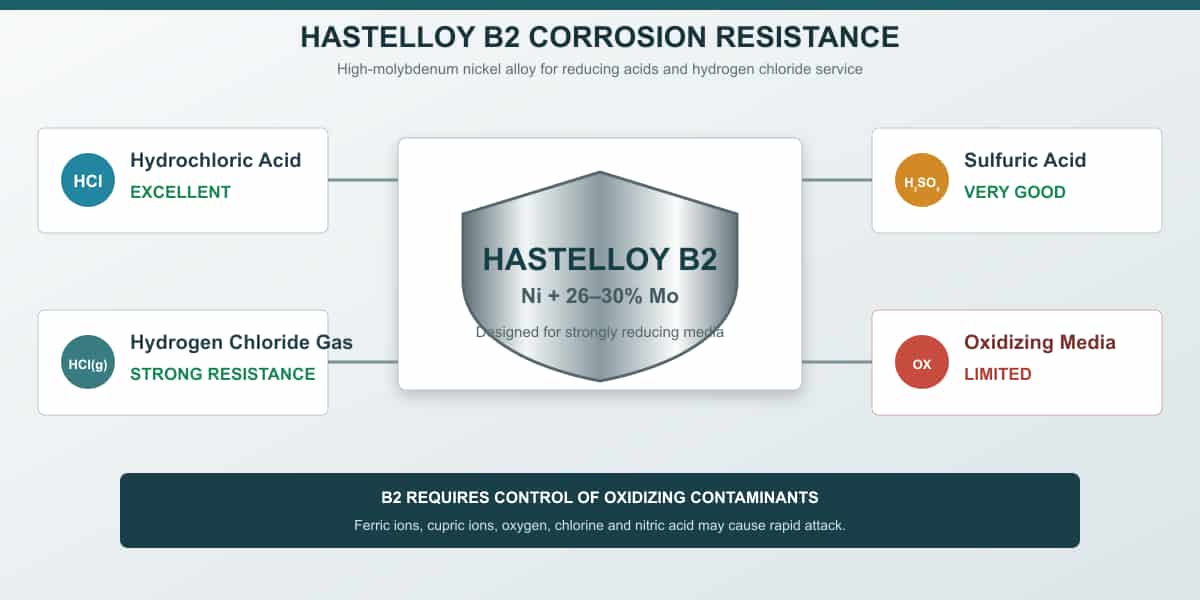
Overview of Hastelloy B2 Corrosion Resistance
Hastelloy B2 is a solid-solution-strengthened nickel-molybdenum alloy designed for severe reducing environments. Its high molybdenum content provides strong resistance to hydrochloric acid and other nonoxidizing acids across broad concentration ranges.
The alloy is used in chemical reactors, acid-transfer piping, heat exchangers, pumps, valves, evaporators, distillation equipment and hydrogen chloride systems. It may also be selected for acetic acid, pharmaceutical intermediates, organic chemical processing and reducing sulfuric acid service.
B2 is not a universal corrosion-resistant alloy. Its low chromium content means that it does not develop the same chromium-rich passive film found on C22, C276 or stainless steel. This characteristic improves its reducing-acid performance but limits resistance to oxidizing chemicals and oxidizing contaminants.
Material selection must therefore answer an important question: will the process remain reducing during normal production, startup, shutdown, cleaning and upset conditions? If oxygen, chlorine, ferric ions or nitric acid can enter the system, a C-family nickel alloy may be safer.
Chemical Composition and Its Role in Corrosion Resistance
| Element | Typical content, wt.% | Role in corrosion behavior |
|---|---|---|
| Nickel | Balance | Provides the ductile matrix and resistance to many reducing chemicals |
| Molybdenum | 26.0–30.0 | Provides outstanding resistance to hydrochloric acid and other reducing media |
| Iron | 2.0 maximum | Restricted to preserve reducing-acid resistance |
| Chromium | Approximately 1.0 maximum | Kept low; limits oxidizing-environment resistance |
| Cobalt | 1.0 maximum | Controlled residual element |
| Carbon | 0.02 maximum | Controlled to reduce detrimental precipitation |
| Silicon | 0.10 maximum | Controlled for weld and microstructural stability |
| Manganese | 1.0 maximum | Processing and deoxidation control |
The high molybdenum level is the defining feature of Hastelloy B2. Molybdenum improves resistance to reducing acids and helps protect the alloy in hydrochloric acid over wide concentration and temperature ranges.
The very low chromium content explains why B2 is unsuitable for many oxidizing chemicals. Chromium normally supports a protective oxide film, but increasing chromium can reduce the performance of nickel-molybdenum alloys in certain strongly reducing acids. B2 is therefore specialized rather than broadly universal.
Resistance to Reducing Environments
Hastelloy B2 performs best in reducing or nonoxidizing environments. These conditions include hydrochloric acid, hydrogen chloride, reducing sulfuric acid, selected phosphoric acid solutions and several organic acids.
Reducing environments have a low oxidation potential and do not normally support the stable passive films used by chromium-rich stainless steels. In these conditions, B2 relies on its nickel-molybdenum chemistry rather than chromium passivation.
The alloy can offer much lower corrosion rates than 316L stainless steel, duplex stainless steel and many chromium-containing alloys in severe hydrochloric acid. However, small amounts of oxidizing contamination may alter this advantage.
Resistance to Hydrochloric Acid Corrosion
Hydrochloric acid resistance is one of the primary reasons Hastelloy B2 is selected. The alloy performs well across many hydrochloric acid concentrations, including conditions where stainless steel and many nickel-chromium alloys experience rapid attack.
Typical applications include hydrochloric acid reactors, storage vessels, transfer piping, pumps, valves, distillation equipment, acid recovery systems and heat exchangers.
Temperature remains important. Corrosion reactions generally accelerate as temperature rises, and boiling conditions can be more severe than ambient exposure. Concentration may also change through evaporation or dilution.
Oxidizing contaminants require particular attention. Ferric chloride, cupric chloride, dissolved chlorine, hypochlorite and oxygen can increase the corrosion rate. A process described simply as “hydrochloric acid” may not be suitable for B2 if significant oxidizing ions are present.
Resistance to Sulfuric Acid Corrosion
Hastelloy B2 provides strong resistance to many reducing sulfuric acid conditions. Its performance depends on acid concentration, temperature, aeration and impurities.
Dilute sulfuric acid may be strongly corrosive because of its conductivity, while concentrated acid can become increasingly oxidizing. B2 is most attractive when sulfuric acid remains reducing and oxidizing contaminants are controlled.
Applications may include acid-transfer equipment, reactors, storage vessels and recovery systems. For hot or concentrated acid, corrosion data should cover the exact concentration-temperature combination.
If the process can shift into strongly oxidizing sulfuric acid conditions, C22 or C276 may provide a more balanced option. The decision should include startup, shutdown and cleaning chemistry rather than normal production alone.
Resistance to Phosphoric and Acetic Acids
Phosphoric acid
Hastelloy B2 can provide good resistance to pure or reducing phosphoric acid solutions. Industrial wet-process phosphoric acid may contain fluorides, chlorides, sulfuric acid, iron compounds and other oxidizing impurities.
When oxidizing contaminants are present, C22 or C276 may provide more reliable performance. Actual process-liquor testing is recommended for contaminated fertilizer and phosphoric acid production streams.
Acetic acid
B2 generally provides excellent resistance to acetic acid, especially under reducing conditions. It may be considered for acetic acid reactors, distillation systems, transfer lines and organic chemical equipment.
Catalysts, chlorides, dissolved oxygen and other organic acids may alter the corrosion behavior. The complete process mixture should be reviewed before final selection.
Resistance to Hydrogen Chloride Gas
Hastelloy B2 offers strong resistance to hydrogen chloride gas under properly controlled reducing conditions. It may be used in gas-generation equipment, transfer lines, absorbers, reactors and process connections.
Dry hydrogen chloride and wet hydrogen chloride are not the same corrosion environment. Moisture can produce concentrated hydrochloric acid on the metal surface, while oxygen or chlorine contamination can make the condensate more oxidizing.
Important variables include:
- Gas temperature
- Water and dew-point level
- Oxygen concentration
- Free chlorine content
- Condensation during startup and shutdown
- Flow velocity and erosion
- Deposits and stagnant areas
Condensation zones are often more corrosive than the bulk gas. The lowest wall temperature and expected condensate chemistry should be included in the material review.
Resistance to Pitting and Crevice Corrosion
Hastelloy B2 provides strong resistance to localized attack in many reducing chloride and acid environments. Its high molybdenum content improves resistance to pitting and crevice corrosion when the process remains reducing.
Its localized-corrosion resistance is not as broadly stable across oxidizing conditions as that of C22 or C276. Oxidizing contaminants can cause attack in crevices, under deposits or near vapor-liquid interfaces.
Equipment design should minimize:
- Gasket crevices
- Lap joints
- Dead legs
- Threaded process connections
- Deposits and stagnant solids
- Rough or incomplete welds
- Areas that cannot drain completely
A low average corrosion rate does not prove that localized attack is absent. Inspection and testing should look specifically for pits and crevice damage.
Resistance to Stress Corrosion Cracking
Hastelloy B2 generally provides strong resistance to chloride-induced stress corrosion cracking compared with common austenitic stainless steels. This is useful in reducing acid and chloride environments where welded or cold-formed equipment retains residual tensile stress.
Stress corrosion cracking requires a susceptible material, a specific environment and tensile stress. Although B2 reduces susceptibility in many reducing environments, unusual conditions involving oxidizers, caustics, sulfur compounds or high temperature require individual evaluation.
Residual stress may come from welding, forming, machining, straightening or assembly. Qualified welding procedures and controlled fabrication reduce the risk of cracking and distortion.
Corrosion Resistance at Different Temperatures and Concentrations
Temperature and concentration must be considered together. A room-temperature test in dilute acid cannot predict performance in hot concentrated service.
| Operating condition | General B2 behavior | Selection guidance |
|---|---|---|
| Dilute reducing acid at ambient temperature | Generally excellent | Confirm oxidizing impurities remain low |
| Concentrated reducing acid at ambient temperature | Often excellent | Review concentration-specific corrosion data |
| Hot hydrochloric acid | Strong resistance across many conditions | Check boiling conditions and contamination |
| Hot sulfuric acid | Good in reducing conditions | Avoid applying reducing-acid data to oxidizing acid |
| Vapor-liquid interface | Potentially more aggressive than bulk liquid | Evaluate oxygen entry and condensate chemistry |
| High-temperature gas | Application-specific | Review gas composition, oxidation and phase stability |
Local wall temperature can be higher than bulk-liquid temperature near heaters, evaporators and heat-exchanger surfaces. Evaporation may also concentrate impurities against the metal.
Limitations in Oxidizing Environments
The main limitation of Hastelloy B2 is poor resistance to strongly oxidizing chemicals and oxidizing contaminants. Its low chromium content does not provide the same passive-film stability as C22 or C276.
Potentially harmful oxidizing species include:
- Nitric acid
- Ferric chloride
- Cupric chloride
- Free chlorine
- Hypochlorites
- Chlorates
- Peroxides
- High dissolved oxygen
- Strong oxidizing catalysts
Even small quantities of ferric or cupric ions can change corrosion behavior. Contamination may enter from raw materials, upstream corrosion, cleaning chemicals, recycled process streams or air leakage.
B2 should not be selected when the process oxidation potential is uncertain or can change during operation. A chromium-containing alloy such as C22 or C276 usually provides a safer balance for mixed oxidizing and reducing environments.
Hastelloy B2 Corrosion Resistance Chart
| Chemical or environment | General resistance | Important consideration |
|---|---|---|
| Hydrochloric acid | Excellent | Control ferric, cupric and chlorine contamination |
| Hydrogen chloride gas | Excellent to very good | Review moisture, oxygen and condensation |
| Reducing sulfuric acid | Excellent to very good | Check concentration and temperature |
| Phosphoric acid | Very good in reducing conditions | Industrial contaminants may change performance |
| Acetic acid | Excellent | Review catalysts, chlorides and oxygen |
| Formic acid | Very good | Confirm hot concentrated conditions |
| Reducing chloride solutions | Very good | Oxidizing ions may cause localized attack |
| Nitric acid | Poor or unsuitable | Strongly oxidizing chemical |
| Ferric chloride | Limited or unsuitable | Strong oxidizing contaminant |
| Cupric chloride | Limited or unsuitable | Can cause rapid corrosion |
| Wet chlorine | Limited | C-family alloys are generally preferred |
| Sodium hypochlorite | Poor or conditional | Strong oxidizing environment |
| Seawater | Conditional | Oxygen and biological activity make it oxidizing |
| Mixed acid streams | Application-specific | Any oxidizing component may control selection |
Hastelloy B2 vs. B3, C22, and C276
| Material | Main strength | Primary limitation or selection note |
|---|---|---|
| Hastelloy B2 | Outstanding hydrochloric acid and reducing-acid resistance | Limited oxidizing resistance and lower thermal stability than B3 |
| Hastelloy B3 | Excellent reducing-acid resistance with improved thermal stability | Still limited in strongly oxidizing chemicals |
| Hastelloy C22 | Excellent balance in oxidizing, reducing and chloride environments | May not equal B-family performance in every pure reducing acid condition |
| Hastelloy C276 | Broad reducing-acid, mixed chemical and chloride resistance | More general-purpose than B2 but composition and cost differ |
Hastelloy B3 was developed to improve the thermal stability and fabrication characteristics of B2 while maintaining strong reducing-acid resistance. It is often considered for new equipment when a B-family alloy is required.
C22 and C276 contain substantial chromium and are more suitable for process streams that contain oxidizing contaminants. B2 can remain the preferred material when the chemistry is reliably reducing and hydrochloric acid resistance is the dominant requirement.
Corrosion-Resistant Applications of Hastelloy B2
Hydrochloric acid processing
Reactors, storage vessels, piping, pumps, valves and heat exchangers may use B2 when oxidizing contaminants are tightly controlled.
Hydrogen chloride systems
Gas generators, transfer lines, absorbers and process connections may use B2 in dry or wet hydrogen chloride service after the full gas and condensate chemistry is reviewed.
Sulfuric acid equipment
B2 may be selected for reducing sulfuric acid transfer, storage, reaction and recovery systems.
Organic chemical production
Acetic acid, selected organic acids, pharmaceutical intermediates, dyes and specialty chemicals may involve reducing process conditions suited to B2.
Vacuum and distillation equipment
Evaporators, condensers, columns and reboilers may use B2 when reducing acid vapors and condensates are present.
Pharmaceutical processing
B2 can be used in selected reaction and transfer equipment where reducing acids are handled and oxidizing cleaning chemicals are excluded or carefully controlled.
Hastelloy B2 Corrosion Resistance FAQs
What chemicals is Hastelloy B2 resistant to?
Hastelloy B2 is highly resistant to hydrochloric acid, hydrogen chloride gas, many reducing sulfuric acid solutions and selected phosphoric, acetic and organic acids. Its suitability depends on temperature, concentration and the absence of oxidizing contaminants.
Is Hastelloy B2 suitable for oxidizing chemicals?
Generally no. B2 has low chromium content and limited resistance to nitric acid, ferric chloride, cupric chloride, free chlorine, hypochlorites and other strongly oxidizing chemicals. C22 or C276 is usually more suitable when oxidizers are present.
What is the difference between Hastelloy B2 and B3?
Both are nickel-molybdenum alloys designed for reducing acids. B3 was developed with improved thermal stability and fabrication characteristics, reducing the risk of embrittlement during welding and elevated-temperature exposure while preserving strong hydrochloric acid resistance.
 English
  French
  German
  Italian
  Spanish
  Portuguese
  Arabic
  Korean