
Hastelloy C276 Operating Temperature: Recommended Range, Maximum Limits and High-Temperature Performance
Hastelloy C276 operating temperature depends on the chemical environment, mechanical load, exposure time, atmosphere and applicable equipment-design code. The alloy, also known as Alloy C276 and UNS N10276, retains useful ductility at cryogenic temperatures and provides oxidation resistance in air at temperatures approaching approximately 1038°C, or 1900°F. However, this high oxidation limit is not a universal allowable temperature for pressure vessels, acid service or continuously loaded equipment. Corrosion rates may become unacceptable at much lower temperatures, and prolonged exposure between approximately 650°C and 1090°C can cause microstructural changes. This guide explains recommended operating ranges, cryogenic performance, continuous and intermittent service, high-temperature strength, oxidation, creep, acid-service limits, welding and material-selection requirements.
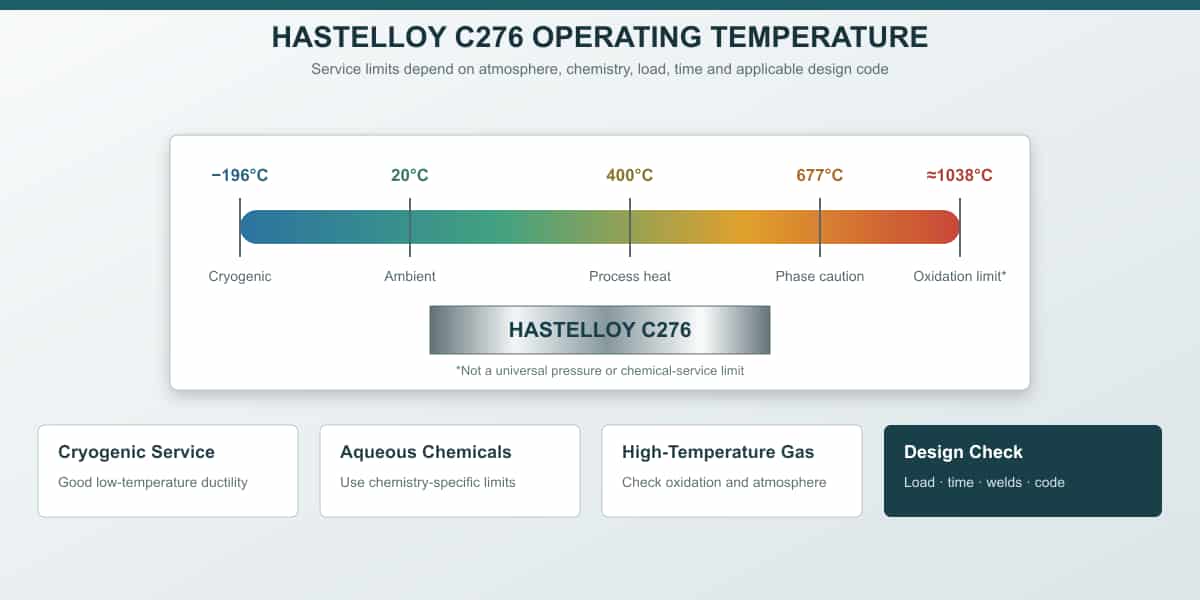
Overview of Hastelloy C276 Operating Temperature
Hastelloy C276 is a nickel-chromium-molybdenum-tungsten alloy developed primarily for severe corrosion resistance. It is widely used in chemical reactors, acid-transfer systems, scrubbers, process piping, heat exchangers, pumps, valves, evaporators and waste-treatment equipment.
Because the alloy has a face-centered cubic nickel-based structure, it does not experience the same sharp ductile-to-brittle transition commonly associated with some ferritic steels. It can retain useful toughness at subzero and cryogenic temperatures when the material and welds are properly qualified.
At elevated temperatures, chromium helps provide oxidation resistance, while nickel contributes to structural stability. Molybdenum and tungsten improve acid and localized-corrosion resistance but can also affect high-temperature oxidation and phase stability.
The operating-temperature limit must therefore answer four separate questions:
- Will the alloy resist the actual chemical environment?
- Will it retain sufficient strength under the applied load?
- Will oxidation or scale formation remain acceptable?
- Will prolonged exposure cause damaging precipitation or microstructural change?
A single maximum temperature cannot answer all four questions. The correct limit is normally the lowest temperature permitted by corrosion data, mechanical design, oxidation behavior, phase stability and the governing construction code.
Recommended Operating Temperature Range
Hastelloy C276 can potentially be used from cryogenic temperatures to high-temperature gas service. The recommended range for a specific component is much narrower and depends on the application.
| Service category | Representative temperature range | Main limitation |
|---|---|---|
| Cryogenic service | Down to approximately −196°C with suitable qualification | Impact toughness, weld quality, contraction and code approval |
| Ambient chemical processing | Approximately −20°C to 100°C | Chemical concentration and localized corrosion |
| Hot aqueous chemical service | Approximately 100–400°C, depending strongly on chemistry and pressure | Corrosion rate, boiling, pressure and vapor-liquid conditions |
| Elevated-temperature structural service | Application-specific | Allowable stress, creep, phase stability and exposure time |
| Oxidizing gas or air | Potentially up to about 1038°C | Atmosphere, scale behavior, cyclic oxidation and mechanical load |
The figures above are screening ranges rather than universal design limits. For example, a C276 component may tolerate hot air at a temperature that would be unacceptable in hydrochloric acid. A thin unloaded shield may also tolerate a higher temperature than a pressure-containing vessel.
Maximum Operating Temperature of Hastelloy C276
A frequently quoted maximum temperature for Hastelloy C276 is approximately 1038°C, or 1900°F, in oxidizing atmospheres. This value relates mainly to oxidation resistance and should not be treated as the maximum allowable temperature for every application.
The actual maximum may be controlled by:
- Loss of mechanical strength
- Creep deformation under sustained load
- Stress rupture
- Microstructural precipitation
- Corrosion in the process chemical
- Reducing or carburizing atmosphere
- Thermal cycling and scale spallation
- Pressure-vessel or piping-code allowable stress
C276 was designed primarily as a corrosion-resistant alloy rather than as a specialized high-temperature creep-resistant superalloy. Materials such as Hastelloy X, Haynes 230 or certain precipitation-strengthened nickel alloys may be more suitable when long-term high-temperature strength is the main requirement.
Minimum and Cryogenic Service Temperature
Hastelloy C276 maintains useful ductility at low temperatures because of its austenitic nickel-based structure. It does not normally show a sharp ductile-to-brittle transition as temperature decreases.
The alloy may be considered for service near liquid-nitrogen temperature, approximately −196°C, when the base metal, welds and fabrication procedure are properly qualified. Applications below this temperature require dedicated material data and code review.
Cryogenic design must consider more than material toughness. Thermal contraction can create high stress at anchors, welded joints, flanges, seals and dissimilar-metal connections. Elastomers, gaskets and coatings may fail at temperatures that the C276 metal can tolerate.
| Cryogenic concern | Design consideration |
|---|---|
| Thermal contraction | Allow movement and evaluate differential contraction |
| Weld toughness | Qualify the welding procedure at the minimum design temperature |
| Impact loading | Confirm impact performance when required by the design code |
| Seals and gaskets | Select nonmetallic materials suitable for the minimum temperature |
| Thermal shock | Control cooling rate and temperature gradients |
Continuous vs. Intermittent Service Temperatures
Continuous service exposes the material to temperature for long periods. Intermittent service includes startup, shutdown, cleaning, short process cycles or temporary upsets. An alloy may tolerate a high temperature briefly but undergo unacceptable oxidation, creep or precipitation during long exposure.
Continuous-service limits are generally more conservative because time-dependent damage accumulates. Creep, stress rupture and precipitation may occur even when the temperature does not cause immediate failure.
Intermittent heating can introduce another problem: thermal cycling. Repeated expansion and contraction may cause fatigue, distortion, cracking at weld toes or scale spallation. A short maximum temperature is not automatically harmless if it occurs thousands of times.
| Service mode | Main concerns |
|---|---|
| Continuous high temperature | Creep, phase precipitation, oxidation and long-term strength loss |
| Intermittent high temperature | Thermal fatigue, distortion and repeated scale formation |
| Rapid heating | Temperature gradients and local thermal stress |
| Rapid cooling | Thermal shock, contraction and joint leakage |
| Temperature cycling | Fatigue at welds, supports, nozzles and sharp transitions |
Mechanical Strength at Elevated Temperatures
The yield and tensile strength of Hastelloy C276 generally decrease as temperature increases. At moderate temperatures, the alloy retains useful strength, but high-temperature design must use temperature-dependent allowable stresses.
| Temperature | General mechanical behavior | Design implication |
|---|---|---|
| 20°C | Full room-temperature strength and ductility | Use product-standard mechanical values |
| 200°C | Moderate reduction in yield strength | Use code-specific allowable stress |
| 400°C | Further strength reduction | Review pressure, support and nozzle loads |
| 600°C | Time-dependent behavior becomes more important | Evaluate creep and exposure duration |
| Above 700°C | Reduced strength and increasing metallurgical concerns | Use specialized high-temperature data and conservative limits |
Room-temperature tensile values should never be used to design hot pressure equipment. Applicable ASME, EN or other design-code tables should be used for the specific material form and temperature.
Corrosion Resistance at Different Temperatures
Corrosion rates generally increase with temperature because chemical reactions accelerate and protective films may become less stable. Temperature can also change chemical concentration, aeration and phase behavior.
In an evaporator, acids and chlorides may concentrate at the heated wall. In a condenser, a hot vapor may form an acidic liquid film that is more corrosive than either the bulk gas or liquid. At a vapor-liquid interface, oxygen and chemical concentration may differ from conditions in the fully immersed zone.
Hastelloy C276 provides broad corrosion resistance, but the maximum temperature should be established separately for each chemical. Manufacturer corrosion curves, laboratory tests and plant operating experience are more reliable than a general temperature rating.
Oxidation Resistance at High Temperatures
Chromium enables C276 to form a protective chromium-rich oxide in many oxidizing atmospheres. The alloy can provide useful oxidation resistance in air at high temperature, with approximately 1038°C often referenced as an upper screening limit.
Atmosphere has a major influence. Air, steam, combustion gas, reducing gas, sulfur-bearing gas, carburizing gas and halogen-containing gas can produce different reactions.
High molybdenum alloys require caution in strongly reducing, stagnant or poorly controlled combustion atmospheres. Oxide volatility, internal oxidation or rapid attack may occur under conditions not represented by air-oxidation data.
Thermal cycling can cause oxide scale to crack or spall. Fresh metal is then exposed during every cycle, increasing oxidation loss. Thin sections and components exposed to direct flame require additional review.
Thermal Stability and Microstructural Changes
Prolonged exposure at elevated temperature may cause precipitation of intermetallic or carbide phases in Hastelloy C276. The approximate range from 650°C to 1090°C deserves particular attention, although precipitation rate depends on exact temperature, time and prior material condition.
Possible effects include:
- Reduced ductility
- Lower impact toughness
- Changes in corrosion resistance
- Reduced weldability during later repair
- Changes in hardness and strength
- Development of local compositional depletion
Brief passage through this temperature range during welding or heat treatment is different from thousands of hours of continuous exposure. Time-temperature-transformation data should be reviewed for long-term service.
Effects of Temperature on Creep and Stress Rupture
Creep is slow, permanent deformation under sustained stress at elevated temperature. Stress rupture is eventual failure caused by the combined effects of temperature, stress and time.
Creep becomes more important as temperature rises, even when the applied stress is below the room-temperature yield strength. Long-term pressure equipment, supports, hangers, tubes and bolting require creep-based design when operating temperatures enter the relevant range.
Factors affecting creep performance include:
- Temperature
- Applied stress
- Exposure duration
- Product form and grain structure
- Weld-metal and heat-affected-zone properties
- Cold work and residual stress
- Corrosion-related section loss
C276 should not automatically be selected for long-term creep service merely because it resists oxidation. A dedicated heat-resistant alloy may provide more reliable high-temperature mechanical performance.
Hastelloy C276 Temperature Limits in Acid Environments
| Acid environment | General temperature behavior | Important limitation |
|---|---|---|
| Hydrochloric acid | Excellent resistance in many concentration and temperature combinations | Hot acid, boiling conditions and oxidizing contaminants require specific data |
| Sulfuric acid | Good to excellent across many conditions | Corrosivity changes substantially with concentration and temperature |
| Phosphoric acid | Generally excellent | Fluoride, chloride and evaporation at heated walls can increase attack |
| Nitric acid | Conditional at high concentration and temperature | Higher-chromium alloys may perform better in strongly oxidizing service |
| Acetic acid | Very good across many temperatures | Review chlorides, catalysts and mixed organic compounds |
| Mixed acids | Often a strong C276 application | Testing should reproduce the complete process mixture |
No general high-temperature limit should replace a chemistry-specific corrosion curve. The temperature measured in the process liquid may also be lower than the actual metal-wall temperature.
Hastelloy C276 vs. Alloy 22 and Alloy 625
| Comparison | Hastelloy C276 | Alloy 22 | Alloy 625 |
|---|---|---|---|
| Main material strength | Broad mixed-acid and chloride resistance | Strong oxidizing and mixed-acid resistance | High strength and broad marine performance |
| High-temperature oxidation | Useful in oxidizing gas up to about 1038°C under suitable conditions | Application-specific; selected mainly for corrosion balance | Good oxidation resistance and stronger high-temperature mechanical performance in many applications |
| Elevated-temperature strength | Moderate; verify creep and code limits | Moderate; verify long-term phase stability | Generally stronger and widely used in elevated-temperature structures |
| Reducing acid resistance | Excellent in many conditions | Very good | Good to very good |
| Oxidizing acid resistance | Very good in many mixed conditions | Often stronger because of higher chromium | Good, depending on chemistry |
Alloy 22 may be selected when hot oxidizing acid resistance is the primary concern. Alloy 625 may be preferred when elevated-temperature strength, fatigue resistance or structural performance is more important. C276 remains highly competitive in mixed reducing-acid and chloride service.
Welding and Heat-Treatment Temperature Considerations
Hastelloy C276 has good weldability when suitable nickel-alloy procedures are used. Its relatively low thermal conductivity causes heat to remain concentrated near the weld, so heat input and interpass temperature must be controlled.
Important welding practices include:
- Using a qualified welding procedure
- Keeping the joint clean and free from iron contamination
- Controlling interpass temperature
- Avoiding unnecessary overwelding
- Using appropriate filler metal
- Removing oxide and heat tint when required
- Balancing welding sequence to reduce distortion
C276 products are commonly solution annealed at approximately 1120°C, followed by rapid cooling. Exact temperature and holding time depend on product form, thickness and material specification.
Routine stress-relief heat treatment is generally avoided unless supported by a qualified procedure because an unsuitable temperature cycle may promote precipitation without fully restoring the solution-annealed structure. Post-weld heat treatment is often unnecessary for properly welded C276 chemical equipment, but design-code requirements take priority.
Selecting Hastelloy C276 for High-Temperature Applications
Define the temperature profile
Record minimum, normal and maximum temperatures, metal-wall temperature, startup and shutdown rates, upset temperature and total time at each condition.
Identify the atmosphere
Determine whether the component is exposed to air, steam, combustion gas, reducing gas, sulfur compounds, halogens, carburizing species or molten salts.
Calculate mechanical loads
Include pressure, dead weight, thermal expansion, vibration, nozzle loads, wind, seismic forces and support reactions. Use temperature-dependent allowable stress.
Evaluate creep and phase stability
For prolonged elevated-temperature exposure, review creep, stress-rupture and time-temperature-transformation data. Do not rely only on room-temperature tensile properties.
Check the chemical environment
Use concentration-temperature corrosion data for every significant chemical. Consider evaporation, condensation, aeration and contaminants.
Review welding and inspection
Confirm filler metal, heat input, interpass temperature, inspection method and repair procedure. Welded areas may control the practical service temperature.
Verify the governing code
Pressure vessels, piping, furnaces and cryogenic equipment may be governed by different codes. The code-approved allowable temperature can be lower than the metallurgical limit of the alloy.
Hastelloy C276 Operating Temperature FAQs
What is the maximum operating temperature of Hastelloy C276?
Approximately 1038°C, or 1900°F, is often cited as an upper oxidation-resistance limit in suitable oxidizing atmospheres. It is not a universal allowable temperature for pressure, acid or continuously loaded service. The actual maximum may be much lower.
Can Hastelloy C276 be used at cryogenic temperatures?
Yes. Its nickel-based austenitic structure retains useful ductility at low temperatures, and it may be considered for service near −196°C when the base metal, welds, seals and design are properly qualified.
Is Hastelloy C276 suitable for continuous high-temperature service?
It can be used in selected high-temperature applications, but prolonged exposure requires evaluation of oxidation, mechanical strength, creep and microstructural precipitation. For high-temperature structural service, Alloy 625 or a dedicated heat-resistant nickel alloy may be more appropriate.
 English
  French
  German
  Italian
  Spanish
  Portuguese
  Arabic
  Korean